What is the best orientation for solar panels?
"Face South!" — this principle has long been considered the gold standard for mounting solar modules. But is it the only option? Learn all about the azimuth angle, tilt angle, east-west orientation, and how to choose the optimal solution for your home.
Anyone building a house today often simultaneously plans a solar energy system. And although every home is unique, one question remains constant: what is the best orientation for solar panels? South-facing modules are ideal for fully utilizing the system's potential — since the sun reaches its highest intensity exactly in the south, around noon.
But not every home — neither new, nor especially older ones — has a roof facing south. And this is not necessarily a problem.
South is not the only direction for solar panels

What alternatives exist for buildings constructed decades ago? Back then, no one thought homeowners would ever use the power of the sun to produce energy. In some cases, building codes even completely prohibited the use of the south-facing roof surface. And even if it is available — neighboring buildings and trees can partially or fully shade the roof and significantly reduce energy generation.
That is why many buildings have a pitched roof oriented to the east and west — the predominant shape in much of Europe.
"This does not mean that homeowners must completely abandon solar energy. Even if south orientation provides the highest performance, most other orientations of PV systems also make economic sense."
Here is how the performance of different orientations compares to the maximum yield of a south-facing system:
Maximum yield. Peak generation at 12:00–14:00. Ideal for battery storage systems.
Only 5% less than the maximum — an excellent choice for any roof type.
Approximately 20% less. West produces more in the afternoon, east — in the morning.
Even supply all day. Losses are especially noticeable in winter.
30–50% less than south-facing. Uneconomical in most cases.
Thanks to modern technologies, a solar power plant is economically viable on almost any building.
East-West orientation: consistency rather than maximums
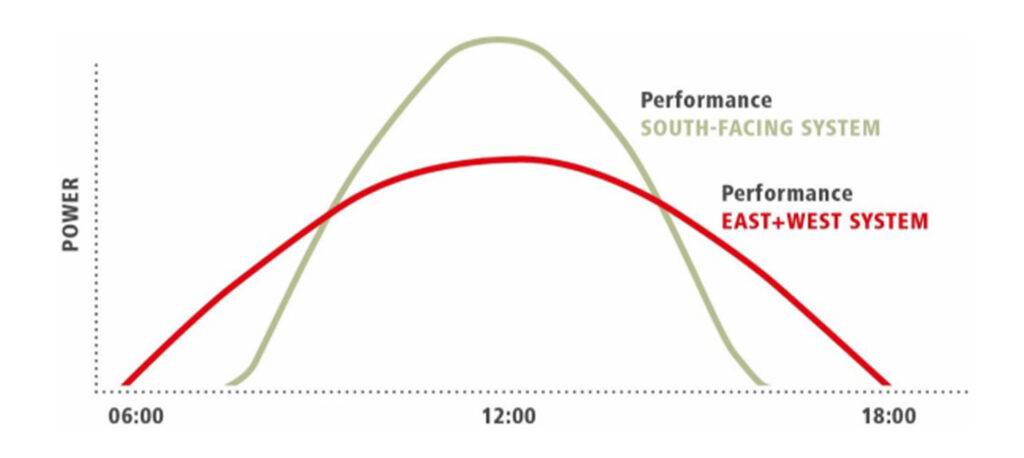
Solar modules oriented to the south reach their peak power around noon and potentially generate significant excess energy during this time. In contrast, an east-west orientation offers much more consistent production — from sunrise to sunset.
"Even if the components rarely reach maximum power with an east-west orientation, the continuous supply of solar energy often reduces the financial burden on households more than a south-facing system — especially in homes without battery storage. East-west systems provide a moderate amount of energy for self-consumption throughout the day, including morning and evening — exactly when we turn on the coffee maker, load the washing machine, or turn on the TV."

There is another advantage that should not be underestimated: if solar modules and inverters do not operate at full load, their components do not heat up to critically high temperatures. This protects the equipment and extends its service life. It may even be worth choosing an inverter with a slightly lower capacity — to reduce initial costs.
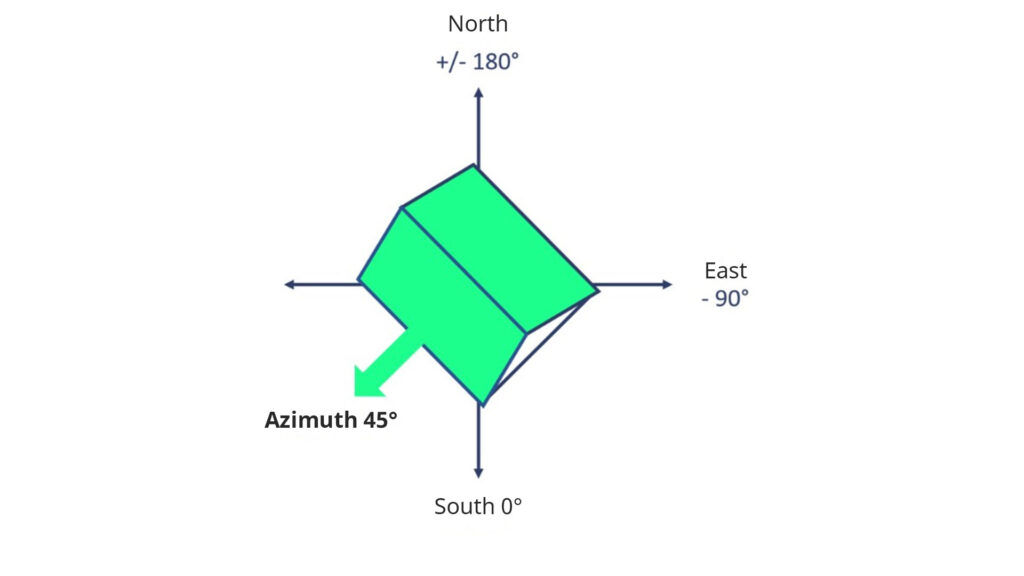
What is the azimuth angle and why is it important?
| Azimuth angle | Orientation | Yield relative to maximum |
|---|---|---|
| 0° | South (true) | Maximum — 100% |
| −45° | Southeast | ≈ 95% |
| +45° | Southwest | ≈ 95% |
| −90° | East | ≈ 80% |
| +90° | West | ≈ 80% |
| ±180° | North | 50–70% |
Optimal tilt angle = optimal power output

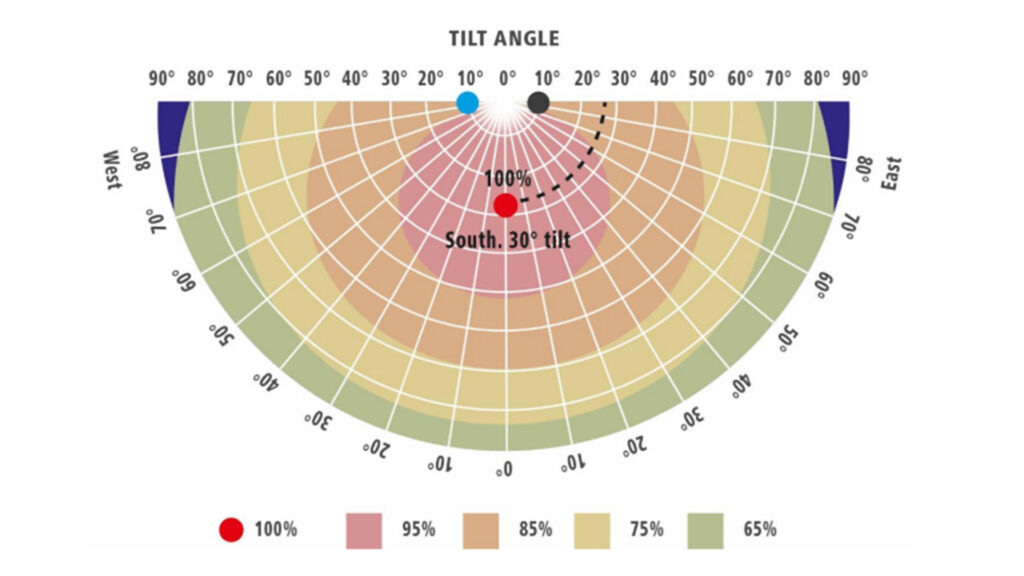
Let's move from the azimuth to the tilt angle. Solar rays should hit the photovoltaic modules not only for as long as possible, but also at a right angle. In Central Europe, a tilt angle of about 30° is optimal for maximum annual power output.
Attentive readers might notice: doesn't the angle of irradiation change throughout the year? After all, the sun is significantly lower in winter than in summer.
Use our solar panel yield calculator to estimate the average monthly generation across regions of Ukraine.
"This observation is absolutely correct. In winter, a tilt angle of over 60° would provide greater performance. However, a suboptimal tilt angle only leads to losses of a few percent during the colder months. In terms of actual kWh, these losses are quite limited, since there are fewer sunny hours in winter and the solar irradiance is significantly lower."
What is better: a flat or pitched roof?
There is no single answer to this question — both types have their own advantages and characteristics.
Pitched roof
- If the tilt angle falls within the optimal range — it is an ideal option
- Steeper roofs provide slightly more energy in winter
- Dirt accumulates less at a steeper incline → lower maintenance costs
- Installation is easier, roof mounts are usually not needed
- Lower installation costs
Flat roof
- Requires expensive mounts to increase the tilt angle
- Optimal angle on mounts: 10–15° — less shading between rows
- East-west systems are highly effective here at 10–15°
- Flexible alignment and orientation options
- Potentially higher revenue due to flexible design

East-west systems, in particular, work extremely efficiently on shallow roofs with a tilt angle of 10–15°. At this angle, the solar modules capture more of the morning and evening sun, which falls at a shallower angle.
In this article, we focused on roof-mounted and in-roof systems. Facade systems and photovoltaic fences have their own specifics and additional advantages.
The right orientation? It all depends on your perspective
Choose east-west if…
…you need a steady supply of a moderate amount of energy from morning to evening. Ideal for households without battery storage — the system covers morning and evening consumption peaks.
Choose south if…
…you want to get the absolute maximum of kilowatt-hours. Peak generation at noon pairs well with a battery storage system that stores the surplus for evening use.
One thing is certain: thanks to modern solar technologies, a photovoltaic system can be economically installed on almost any home. Failing to utilize the potential of your own roof will cost homeowners more in the long run than a one-time investment in a solar power plant.
Find the optimal orientation with Total Energo
Not sure which orientation is right for your home?
Our engineers will analyze your roof, calculate the optimal azimuth and tilt angle, and propose the most effective solution — taking into account the roof type, shading, and your consumption needs.