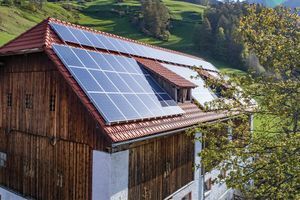
The shadow that kills your solar system
Why shadow is the worst enemy of a solar system
A shadow on a solar panel is not just "less sun". Due to the physics of series connection, even a small amount of shading can wipe out the output of an entire string and cause severe overheating of the cells.
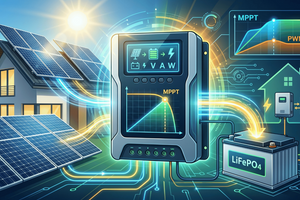
Based on Victron Energy equipment — SmartSolar MPPT controllers and the VRM monitoring system — you can not only protect against the effects of shading, but also detect problem areas before they kill your battery and panels.
Total-Energo LLC specialists perform a shading analysis prior to installation and select a system architecture that minimizes losses.
What we cover in this article
1 Physics of the shading effect and bypass diodes
2 Sources of shadow and how to anticipate them
3 Hot spots — why they are dangerous
4 How Victron MPPT handles shadows
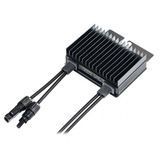
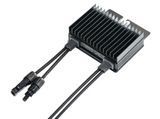
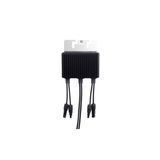
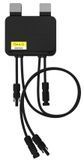
5 Optimizers and microinverters
6 System design rules
How shadow ruins a string — interactive diagram
☀️ All 5 panels are evenly illuminated. The string delivers the full power of 500 W (nominally 100 W per panel). The current is only limited by the load.
with shadow on 1 out of 5 panels
temperature of the shaded cell
of modules without shadow protection
Typical sources of shading — know your enemy
Hot spots — the hidden danger
A shaded panel cell becomes a consumer — it absorbs the power of the entire string and dissipates it as heat. The temperature can reach 150–200°C. The result is accelerated degradation, delamination, cracks, and in extreme cases, panel fires.
The bypass diode "switches off" the shaded section, but this means: this area no longer produces energy, and the entire string is current-limited due to the series connection effect.
Power curve under shading — where the MPP hides
Blue curve — normal operation. One distinct MPP peak. A classic inverter easily finds the optimal point.
How Victron controllers handle shadows
The problem with a classic inverter
A conventional inverter looks for a single MPP point on the power curve. When shading occurs, the curve takes a shape with multiple humps. The classic algorithm gets "stuck" on a local maximum — and the system produces only 25–30% of its potential.
This is a fundamental limitation that cannot be "adjusted" — it can only be bypassed via hardware or advanced algorithms.
SmartSolar MPPT — adaptive algorithm
- Full scan of the I-V curve every 15 minutes
- Detection of the "double hump" during partial shading
- Selection of the global MPP instead of the local one
- Rapid response to changes in cloud cover and shadows
- Real-time monitoring via the VRM Portal
- Alerts for abnormal drops in generation
- A dedicated MPPT for each string — the optimal solution
What to do — from basic to advanced
Read more — expand the relevant section
How shading is analyzed prior to installation
Shading analysis is a mandatory step before any project from 1 kW. It is performed using specialized software and shows annual losses from shading down to the exact percentage.
- A 3D model of the site with all obstacles (buildings, trees, antennas)
- Sun trajectory calculation for your latitude throughout the year
- Shading map for each panel at any given hour
- Comparison of string placement options
- Choosing between a standard inverter, optimizers, or microinverters
- Forecast of annual generation factoring in real shadows
Total-Energo specialists perform this analysis before every project. The cost of the analysis pays for itself in the very first season through correctly selected equipment and placement.
Why you shouldn't parallel strings with different shading
If two strings with different illumination levels are connected in parallel to a single MPPT tracker, the controller is forced to find a "middle" compromise MPP — and ends up optimizing neither of them.
❌ Incorrect
String A (full sun) + String B (partial shadow) → one MPPT. Result: both strings lose power, and the MPPT "chooses" a point between them.
✅ Correct
String A → MPPT 1 (finds its own MPP). String B → MPPT 2 (finds its own MPP). Each string delivers maximum output regardless of its neighbor.
LiFePO4 and shadows — special risks
Lithium batteries require a stable and correct charging profile. With shading, the system may "jump" between different operating modes — and this places a load on the BMS.
- An unstable charging current from the MPPT due to sudden shadow changes accelerates wear
- The BMS may disconnect the battery in the event of abnormal current pulses
- Victron SmartSolar properly manages LiFePO4 charging even with unstable sunlight
- The VRM Portal allows tracking the number of "abnormal" BMS disconnections
What we recommend for shadow protection
The optimal approach — step by step
Designing solar systems without shading losses
We will perform a shading analysis, select an architecture based on Victron Energy, and calculate the actual generation taking all factors of your property into account.