Apartment Autonomy: Inverter and Balcony Panels
A guide to creating backup power in a high-rise building: does a balcony solar station make sense, how to choose an apartment inverter, and how to safely connect it to the electrical panel.
Energy independence in an apartment — myth or reality?
Until recently, it was believed that solar panels and inverters were exclusively for private houses. However, blackouts have changed the rules of the game.
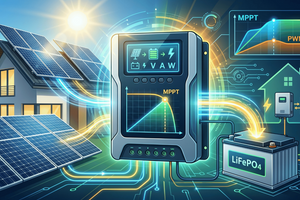
Today, a hybrid inverter for an apartment paired with a LiFePO4 battery is the most profitable alternative to portable power stations. A couple of flexible panels on the balcony can support your router and laptop even during the longest outages.
Our engineers design apartment systems every day — contact us for a free estimate tailored to your needs.
What we will cover
1 Do balcony solar panels really work?
2 Inverter vs Power Station (EcoFlow)
3 Proper connection to the panel (ATS)
4 Autonomy time calculator
5 Which batteries are safe for indoor use
6 Ready-made solutions for apartments
Balcony solar panels: expectations vs reality
🌤️ Main rule: It's for support, not full autonomy
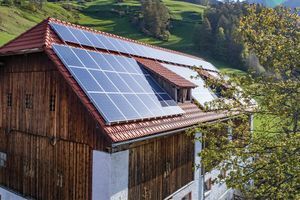
Installing panels on a balcony is possible (and legal), but you need to be realistic. Due to limited space and tilt angle, a balcony solar station typically generates between 100 to 400 W per hour on a sunny day.
This won't be enough to boil a kettle or power a water heater, but it is perfectly sufficient to charge the battery, power a router, laptop, refrigerator, and efficient LED lighting during daylight hours without depleting your main battery.
The hybrid inverter automatically charges the battery from the city grid (when power is available). When the grid fails, it switches the apartment to battery and solar power instantly (in 10-20 ms).
Can run a fridge, TV, heating pump
No permits needed for zero-export systems
Your appliances won't even notice the blackout
What's better: Hybrid Inverter or Portable Power Station?
🔋 Portable Power Station (EcoFlow, Bluetti)
A plug-and-play solution. Ideal for rented apartments or if you frequently need to move your power source.
● Pros: No installation required, highly mobile.
● Cons: Very high price per 1 kWh of capacity.
● Cons: Extension cords all over the apartment (if not wired to the panel).
● Cons: Noisy fans during charging.
🧠 Inverter + LiFePO4 Battery ⭐ Recommended
A stationary system that integrates directly into your apartment's wiring. When the lights go out, your outlets keep working.
● Pros: 2-3 times cheaper than a portable station of similar capacity.
● Pros: Scalable (you can buy more batteries later).
● Pros: No extension cords — your regular wall outlets and switches work.
● Cons: Requires an electrician for installation.
⚠️ CRITICAL: How to connect the inverter in an apartment
Never connect an inverter using a "plug-to-plug" (suicide) cable into a wall outlet! This is deadly dangerous for grid workers repairing the line and will guarantee your inverter burns out when the power suddenly returns.
Proper connection must be done only through the electrical breaker box using an Automatic Transfer Switch (ATS) or a manual changeover switch (I-0-II). This physically disconnects your wiring from the city grid before feeding inverter current.
How many hours will the battery last?
This calculation is approximate. Refrigerators run in cycles, so actual runtime might be even longer.
How to choose equipment for an apartment
Battery: Why ONLY LiFePO4?
Only Lithium Iron Phosphate (LiFePO4) batteries are suitable for use inside residential spaces.
- Safety: They do not emit toxic or explosive gases during charging (unlike lead-acid, acid, or regular car batteries). They do not catch fire.
- Lifespan: They withstand 3000 to 6000+ cycles (that's over 10 years of daily outages). An AGM battery "dies" after 300-500 deep discharge cycles.
- Charging Speed: LiFePO4 can be charged from 0 to 100% in just 1-2 hours, which is critical when power is only on for 2 hours between 4-hour outages.
Inverter Power: 3 kW is the sweet spot
For most apartments, a 3 kW (3000 W) inverter with a 24V system voltage is optimal.
This power is enough to simultaneously run a refrigerator (accounting for its starting surge), a TV, computers, lighting, and a microwave. If you plan to power a water boiler, washing machine, or a powerful electric oven during blackouts, you will need a 5 kW (48V) system.
Warning: Always choose an inverter with a Pure Sine Wave. A modified sine wave will burn out the control boards in gas boilers and refrigerators, and cause circulation pumps to buzz loudly.
Popular solutions for apartments
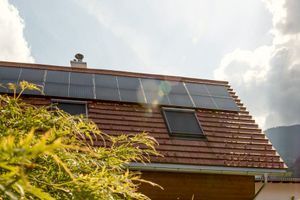
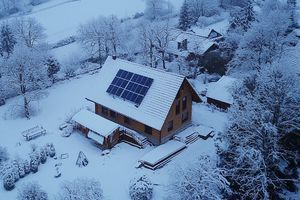
Installing panels on a balcony makes sense if it faces south, southeast, or southwest. Vertical mounting cuts up to 30% of generation compared to a roof, but in winter (when the sun is low) the vertical placement works perfectly.
Rules for installing a system in an apartment
Things to remember:
💡 Let us help you choose a system for your apartment
Tell us about your appliances and requirements — we will select a reliable inverter and battery that will fit your apartment perfectly, free of charge.