Hybrid or Off-grid? How to choose an inverter for your home
An inverter is the "brain" of your power system. Let's figure out the difference in technologies, what inrush currents are, and how to correctly select the power capacity so you don't fry your appliances.
What does an inverter do and why is it so important?
Batteries store energy as direct current (12, 24, or 48 Volts). But your household appliances need alternating current (220/230 Volts).
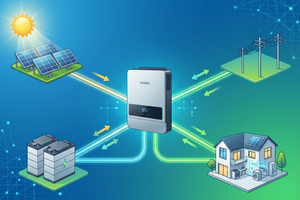
The inverter's job is to convert this current with minimal losses. A modern inverter also decides when to charge the battery, when to draw power from the city grid, and if you have solar panels — how to extract maximum efficiency from them. How "smart" this device is determines the lifespan of your batteries and the safety of your boiler.
What we'll cover:
1 Off-Grid vs. Hybrid: what's the difference
2 The magic of energy "mixing"
3 Why a pure sine wave saves appliances
4 The trap of inrush currents (Calculator)
The main battle: Off-grid vs. Hybrid
🔌 Important terminology
Many buyers get confused by the names. "Off-grid" doesn't mean it can't be connected to the 220V city grid. Both types of inverters connect to the grid, charge batteries, and power the house. The main difference is WHAT they do with solar energy.
🔌 Off-Grid Inverter
Works like a hard switch (relay). It either takes power ONLY from the sun/battery, or ONLY from the city grid. It cannot mix them.
● Pros: 30-40% cheaper.
● Pros: Ideal for simple backup power (UPS).
● Cons: Loses some solar generation if home consumption is low.
● Cons: Cannot sell excess power back to the grid (Feed-in tariff).
🧠 Hybrid Inverter ⭐ Experts' Choice
This is a true energy computer. Its main feature is the mixing function (Grid-Tie). It can draw energy from different sources AT THE SAME TIME.
● Pros: Can mix energy (e.g., 2 kW from the sun + 1 kW from the grid).
● Pros: Allows selling electricity to the state (Net Billing).
● Pros: Highly flexible priority settings.
● Cons: Higher initial equipment cost.
A hybrid inverter takes the maximum amount of free energy from the sun, and whatever is missing is seamlessly "drawn" from the grid without switching over or draining the battery.
⚠️ CRITICAL: Why will a modified sine wave kill your boiler?
In a city wall outlet, current flows as a smooth wave — this is a "pure sine wave". Cheap mass-market inverters generate current in steps (squares) — this is a "modified" sine wave. For charging a smartphone, this isn't a big deal.
But if you plug in a gas boiler, circulation pump, modern refrigerator, or washing machine — their electric motors will start humming, overheating, and with 90% probability, their control board will burn out within a few hours. We design systems exclusively based on Pure Sine Wave inverters.
The trap of inrush currents: How many kilowatts do you really need?
The most common mistake: "My fridge consumes 150W, TV 100W, boiler 100W. So a 500W inverter is enough!" This is wrong. Any device with a compressor or motor consumes 3-7 times more energy in the first 1-2 seconds after turning on (inrush current). If the inverter doesn't have the reserve capacity to "digest" this spike, it will simply shut down.
An inverter is always selected based on the peak load with a reserve of at least 20% so the system operates without overloads.
Which inverter is right for your home: 3 kW, 5 kW, or more?
✅ Pre-purchase checklist:
Need help choosing?
You don't have to be an expert in volts, amps, and sine waves. Our engineers will do it for you. We will select the perfect inverter and batteries for your budget and home needs for free.