Victron MultiPlus-II or Deye:
which inverter is better for a home in Ukraine
This material was prepared by the specialists of Total-Energo LLC in response to the recurring question, «Which should I buy — Victron or Deye?» We examine it using a 6 kW, 230 V inverter as the example.
Selecting a home inverter in Ukraine cannot be reduced to comparing nominal power and equipment price. With a stable grid, an inverter may be used for years primarily for solar generation and occasional emergency outages. Conditions in Ukraine are considerably more demanding.
The primary design scenario in this article is a winter schedule that has repeatedly become a reality for Ukrainian consumers:
❄️ Ukrainian Winter Scenario
🎯 The Right Question
We recommend framing the question correctly: which system can operate every day under demanding cyclic conditions, recharge the batteries in time, accept an unstable grid, work correctly with a generator, and remain repairable after five or ten years?
For a direct comparison, we consider two single-phase systems rated at approximately 6 kW. The situation is broadly similar for three-phase systems.
Configurations Being Compared
🔵 Victron Energy System
inverter/charger Victron Energy MultiPlus-II 48/6k5/100-50 GX
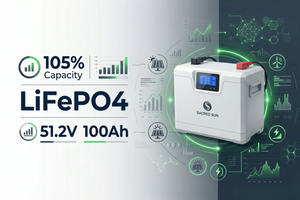
Sunlight Power.ESS Li.ON 51.2 V, 100 Ah batteries
a separate SmartSolar MPPT when solar panels are connected
🔴 Deye System
Deye SUN-6K-SG06LP1-EU hybrid inverter
Deye SE-G5.1 Pro-B 51.2 V, 100 Ah batteries
integrated MPPT charge controllers
integrated display and cloud monitoring
📌 Main Conclusion
The Deye SUN-6K-SG06LP1-EU is a feature-rich all-in-one hybrid inverter. Its enclosure contains the inverter and charger, two MPPT charge controllers, a display, grid functions and the control system. It is a convenient option for a customer who wants a compact solar ESS with a relatively low initial cost.
The Victron MultiPlus-II 48/6k5/100-50 GX is the foundation of a modular energy system with a powerful integrated controller for monitoring, management and service support. Separate components are added for solar generation and automation. The initial system cost is higher, but the owner receives flexible architecture, sustained overload capability, PowerControl and PowerAssist functions, a mature software ecosystem, incremental expansion, and the ability to service, scale, or even replace individual components independently.
For the Ukrainian scenario of daily prolonged outages, we consider the Victron MultiPlus-II GX with Sunlight Power.ESS batteries the more secure long-term choice — provided that battery capacity, charging current, power cables and protective devices are engineered professionally.
Even the most reliable inverter cannot solve the problem when it is connected to a single battery with insufficient current capability.
Is it valid to compare Victron and Deye inverters?
Victron and Deye represent different approaches to building a home backup and solar power system, so the comparison is not straightforward.
The MultiPlus-II combines a high-capacity grid transfer switch, DC/AC inverter, AC/DC charger, PowerControl, PowerAssist and a VE.Bus interface for parallel or three-phase operation. The inverter has two load outputs for backed-up and non-backed-up consumers.
For complete remote monitoring, an inverter version with an integrated GX is used, or an external Cerbo GX or Ekrano GX controller is added. Solar panels are connected through a separate SmartSolar MPPT, or AC-coupling is used with a compatible grid-tied solar inverter.
This type of system costs more and requires competent engineering. It is, however, more convenient and reliable in operation. Its individual elements can be selected, expanded, serviced and replaced independently. Each node is configured separately, while the system operates as a single coordinated whole.
The SUN-6K-SG06LP1-EU already contains a single-phase inverter, charger, two MPPT trackers, solar-panel inputs, a local display, communication interfaces and energy-management algorithms.
The advantages are fewer separate devices, simpler installation, an integrated solar section and a lower initial budget threshold for entering an energy-storage system.
The other side of integration is that failure of the single unit may simultaneously disable the inverter, charging and solar sections of the system. In a modular system, failure of an individual MPPT or communications centre does not necessarily mean loss of backup power.
The system cannot be scaled: Deye inverters do not operate in parallel or in three-phase networks, future power expansion or conversion to a 400 V system is not possible, numerous different PV arrays cannot be connected, and fine optimisation of generator starting and stopping cannot be configured. These limitations are examined below.
Comparison of Key Specifications
| Parameter | 🔵 Victron MultiPlus-II 48/6k5/100-50 GX | 🔴 Deye SUN-6K-SG06LP1-EU |
|---|---|---|
| Architecture | Modular inverter/charger | All-in-one hybrid inverter |
| Nominal active power | 6000 W | 6000 W |
| Sustained overload capability | 6500 W ≤ 4 hours 8000 W ≤ 1 hour 11000 W ≤ 1 minute |
Not supported |
| Peak power | ≤ 11 000 W | ≤ 12000 W |
| Output at elevated temperature | Specific derating values are published | Power reduction is stated after a specified temperature threshold; the detailed curve should be checked in the manual |
| Maximum efficiency | Up to 96% | Up to 97.6% according to the manufacturer |
| Grid pass-through | = 50 A | ≤ 50 A |
| Battery voltage range | 48 V system, operating range depends on settings and the BMS | Low-voltage 48 V system |
| Maximum charger current | 100 A at +25 °C | Up to 135 A through the battery port for the series considered |
| Integrated MPPTs | No | Yes |
| Solar capacity | Unlimited | Limited by the integrated MPPT |
| Suitable for complex roofs | Yes, the required MPPT controller set can be selected optimally | No, not suitable |
| Remote monitoring | Through Cerbo GX/Ekrano GX and VRM — modern European-grade software | Integrated display, Wi-Fi and the Deye cloud platform — limited capabilities and localisation issues from a Chinese manufacturer |
| Parallel operation | Yes | Yes, within configurations permitted by the manufacturer |
| Three-phase configuration | Yes | Depends on the model and engineered configuration |
| Cooling | Active, fan-assisted, intelligent | Passive or active — depending on the hardware revision |
| Standard warranty | 5 years, with an official extension to 10 years available | 2…5 years through an official import channel |
How do Victron and Deye inverters differ in operation?
Although both inverters have a nominal output of 6 kW, this does not mean they will behave identically when starting a pump, compressor, air conditioner or other electric motor.
Deye emphasises high short-duration peak power. In addition to its peak rating, Victron publishes operating durations at several overload levels. For a residential system, it is important to assess not only the maximum number in a marketing table, but also how long the power stage can sustain the elevated load.
This is critical for the following loads:
borehole and circulation pumps
refrigeration and freezer compressors
air conditioners and heat pumps
gate motors
pumping stations
power tools
loads with high starting current or a low power factor
A brief peak may be sufficient for a rapidly starting motor. If a motor accelerates slowly, a compressor starts under pressure, or several loads start simultaneously, the duration of the overload becomes as important as its maximum value. The latest-generation MultiPlus-II 6k5 can sustain significant overloads for extended periods, whereas Deye provides peak power for only 20 ms.
Temperature affects inverter output
Victron Energy consistently publishes the reduction in available power as temperature rises. For the MultiPlus-II 48/6k5, the figures are 6000 W at +25 °C, approximately 5700 W at +40 °C, and further reduction at extreme temperatures.
The inverter nevertheless continues operating at ambient temperatures up to +65 °C, allowing it to be used in demanding conditions such as outdoor enclosures, vehicles, production areas and boiler rooms.
Deye states an operating-temperature range and the threshold at which derating begins, but the curve for the specific model and hardware revision must be used for engineering calculations. The Chinese manufacturer does not publish open detailed data, which may indicate poorer performance than its competitors. When a Deye inverter is installed in a small boiler room, metal enclosure, attic or poorly ventilated technical space, the temperature inside the equipment may be substantially higher than room temperature. The inverter should therefore be selected with a margin rather than expected to operate continuously at its maximum nameplate power.
The batteries must match the inverter: one 5.12 kWh battery is insufficient for a 6 kW inverter
A 51.2 V, 100 Ah battery has a nominal energy reserve of 5.12 kWh. Energy capacity and permissible power, however, are different parameters.
To deliver 6 kW at the inverter output, the approximate battery current required is:
At an efficiency of approximately 95–96%, the current is about 122–125 A. It rises further as battery voltage falls.
One Sunlight Power.ESS 51.2 V, 100 Ah module and one Deye SE-G5.1 Pro-B module are rated for a recommended continuous current below the demand of a fully loaded 6 kW inverter. The BMS may limit the current or disconnect the battery if the permissible operating range is exceeded.
A 6 kW inverter should use at least two battery modules, not only for autonomy but also to provide the required permissible discharge current.
(Exceeded)
(Optimal)
(Gentle regime)
With two batteries, current is shared between the modules. At a 6 kW load, each battery supplies approximately 60–65 A. Three batteries provide a gentler operating regime of about 40–45 A per module at full inverter output.
Comparison of Sunlight and Deye batteries
For illustration, we compare two different batteries. For the premium-class Victron Energy MultiPlus-II 48/6k5/100-50 inverter, we use a battery from the Greek manufacturer Sunlight — one of Europe’s largest established factories with high industrial production quality. For Deye, we use the manufacturer’s own battery.
| Parameter | 🔵 Sunlight Power.ESS 51.2 V, 100 Ah | 🔴 Deye SE-G5.1 Pro-B 51.2 V, 100 Ah |
|---|---|---|
| Chemistry | LiFePO₄ | LiFePO₄ |
| Nominal voltage | 51.2 V | 51.2 V |
| Nominal capacity | 100 Ah | 100 Ah |
| Nominal energy | 5.12 kWh | 5.12 kWh |
| Usable DC energy | Approximately 4.92 kWh for the current series according to the manufacturer’s documentation | Approximately 4.6 kWh according to the manufacturer’s documentation |
| Recommended charging current | Up to 70 A | Approximately 50 A |
| Maximum charging current | Up to 70 A | Up to 50 A |
| Recommended discharge current | Up to 50 A | Up to 50 A |
| Maximum discharge current | Up to 100 A | Up to 100 A |
| Short-duration current | 149 A — elevated short-duration current under the BMS algorithm | Up to 150 A for a short duration, according to the model documentation |
| Interfaces | CAN, RS485 | CAN, RS485 |
| Parallel connection | Up to 32 modules for the current series | Up to 64 modules, depending on the configuration |
| Declared cycle life | 6000+ cycles under the stated operating conditions at 90% depth of discharge | 6000+ cycles under the stated operating conditions at 80% depth of discharge |
| Ingress protection | IP20 | IP20 |
| Warranty | 10 years | 5 years |
What the difference in usable capacity means
At the same nominal capacity of 5.12 kWh, Sunlight states a larger available energy reserve than the Deye SE-G5.1 Pro-B. The difference is approximately 0.32 kWh per module.
For two batteries, the difference is approximately 0.64 kWh. At an average load of 1 kW, this may provide roughly 30–40 additional minutes of autonomy after inverter losses are taken into account.
Matching charger capacity to the number of batteries
MultiPlus-II has a 100 A charger. One Sunlight module is rated for a recommended 70 A, below the charger’s full capability. With one battery, the MultiPlus-II charging current must therefore be limited in software; this limitation is applied automatically.
With two Sunlight batteries, the combined recommended current is 140 A. Two modules therefore allow the full 100 A charger output to be used without exceeding the recommended 70 A per battery.
Deye can operate at up to 135 A through the battery port; depending on the hardware revision, the charger may instead be rated at 70 or 100 A. A single Deye battery, however, has a recommended current of approximately 50 A and a maximum of 100 A. The full 135 A is not permissible for one module. With three batteries, 135 A is divided into approximately 45 A per module and remains within the recommended operating range.
A high inverter charging current is useful only when the battery system can accept it.
Adding batteries in the future
One way to purchase high-quality equipment is to buy the inverter with one battery initially and expand the installation progressively by commissioning additional battery modules. This increases the permissible charging power and the available battery autonomy.
For Sunlight batteries, additional modules should preferably be added within the first two years of operation so that all elements in the combined battery bank can operate in a balanced and consistent manner.
How many batteries are required for 6–8-hour outages in Ukraine?
Knowing the home’s maximum power demand is not sufficient. The average load during the outage must be determined.
A home may briefly consume 5–6 kW or more when a kettle, hair dryer or microwave oven is switched on, particularly when several adults live in the property, while its eight-hour average load may be only 700–800 W. Another home may have no electric cooker but continuously operate heating-system pumps, computers, refrigeration equipment and lighting with a combined average load of 1.8 kW.
For an indicative calculation, assume that approximately 90% of the stated usable DC energy reaches the AC load after inverter efficiency, an engineering reserve, temperature and gradual ageing are taken into account. This is not a manufacturer-specified coefficient, but a conservative engineering assumption.
| Number of batteries | Average load | 🔵 Victron + Sunlight | 🔴 Deye + Deye |
|---|---|---|---|
| 2 | 0.8 kW | Approximately 11.1 hours | Approximately 10.3 hours |
| 2 | 1.2 kW | Approximately 7.4 hours | Approximately 6.9 hours |
| 2 | 1.5 kW | Approximately 5.9 hours | Approximately 5.5 hours |
| 2 | 2.0 kW | Approximately 4.4 hours | Approximately 4.1 hours |
| 3 | 1.2 kW | Approximately 11.1 hours | Approximately 10.3 hours |
| 3 | 1.5 kW | Approximately 8.9 hours | Approximately 8.3 hours |
| 3 | 2.0 kW | Approximately 6.6 hours | Approximately 6.2 hours |
| 4 | 3.0 kW | Approximately 8.9 hours | Approximately 8.3 hours |
💡 Practical Recommendation
Can the system recharge in 2–3 hours?
During prolonged outages, charger power becomes one of the key system parameters, provided that the supply line has enough capacity to charge the battery bank while powering household loads simultaneously.
Assuming a battery voltage of approximately 53 V during the main charging stage, the theoretical power is:
This is battery-side power. The actual value depends on BMS limits, the number of batteries, temperature, current SOC, household load, permissible incoming current, inverter settings, grid quality and the charging stage.
| Configuration | Usable DC energy | Calculated current | Practical benchmark with no household load |
|---|---|---|---|
| 🔵 2 × Sunlight | 9.84 kWh | 100 A | Approximately 2.1–2.4 hours |
| 🔵 3 × Sunlight | 14.76 kWh | 100 A | Approximately 3.1–3.5 hours |
| 🔴 2 × Deye | 9.2 kWh | Approximately 100 A in the recommended operating range | Approximately 2.0–2.3 hours |
| 🔴 3 × Deye | 13.8 kWh | Up to 135 A, approximately 45 A per module | Approximately 2.2–2.6 hours |
The home continues to consume electricity while the grid is available. If the household load is 1.5 kW and the charger consumes approximately 5.5–5.8 kW, the incoming supply must deliver about 7 kW in total, excluding short-duration peaks.
If the allocated household capacity, incoming circuit breaker, voltage stabiliser or supply line cannot carry this current, charging must be limited. The batteries may consequently fail to recover before the next outage.
The advantage of Victron Energy PowerControl and PowerAssist
PowerControl allows a maximum current to be set for power drawn from the grid or generator. As the household load rises, the MultiPlus-II reduces charging current to avoid overloading the source.
PowerAssist works in the opposite direction: if the grid or generator cannot supply a short-duration peak, the MultiPlus-II supplements it with battery energy. This does not increase the energy available from the grid, but it allows the available power to be allocated intelligently between the home and battery charging.
Voltage stabiliser — is it required?
A common misconception is that every hybrid inverter automatically stabilises the incoming grid voltage.
When the inverter operates from batteries, it does generate its own stable output voltage. When an acceptable grid is present, however, most systems synchronise with it, enable pass-through and transfer the input voltage to the output.
If the voltage is too low or too high, the inverter does not accept the grid:
grid pass-through is not enabled;
the charger does not start;
the home continues operating from the batteries;
the brief window of available electricity is lost.
MultiPlus-II has a specified AC input range, and the grid-acceptance thresholds can be adjusted within the limits permitted by the manufacturer. After synchronisation, the output voltage follows the accepted input supply. Deye also accepts the grid only within the range defined by the grid profile and settings. However, its voltage range is considerably narrower, which often creates additional expenditure on voltage stabilisers.
| Manufacturer | Minimum voltage required to start operation | Minimum operating voltage | Maximum operating voltage |
|---|---|---|---|
| 🔵 Victron Energy MultiPlus II 48/6k5/100-50 | 187 V | 180 V | 265 V |
| 🔴 Deye SUN-6K-SG05LP1-EU | 196 V | 195 V | 253 V |
The Victron Energy MultiPlus-II 48/6k5/100-50 can operate over a wide input range, which is a major advantage: after grid power returns, voltage is often outside the nominal value, yet the batteries can still be charged under these conditions.
What a voltage stabiliser provides
A voltage stabiliser installed upstream of the inverter AC input can raise low voltage to an acceptable level. The inverter can then synchronise with the grid, enable pass-through, begin charging the batteries and stop consuming battery energy while mains power is actually available.
In a «2–3 hours with grid, 6–8 hours without grid» scenario, the voltage stabiliser may be more critical than a difference of several percentage points in inverter efficiency.
Recommended connection logic
The system should also include a manual bypass for the voltage stabiliser, a manual inverter bypass, selective overcurrent protection, correct neutral switching, surge protection devices, proper earthing, RCDs or RCBOs and voltage monitoring upstream and downstream of the stabiliser.
The specific circuit must be designed for the building earthing arrangement, incoming rating and requirements of the selected equipment. Total-Energo LLC engineers supply and install all these elements, making the installation convenient and safe to operate under any foreseeable condition.
How to size a voltage stabiliser correctly
The charger power, simultaneous household load, minimum input voltage, voltage-stabiliser efficiency, power factor, starting currents and the reduction in permissible output at low voltage must all be taken into account.
Assume the household load is 1.5 kW, the charger consumes 5.6 kW, the voltage stabiliser efficiency is 95% and the power factor is 0.98.
At an input voltage of 160 V, the calculated current is about 48 A. With a 25% margin, it is approximately 60 A. At 150 V, the calculated current approaches 51 A and approximately 64 A with the margin.
Consequently, a voltage stabiliser advertised as «7 kVA» may be insufficient. With severe grid sag, a 10–12 kVA unit or larger is often required, but the final selection must be based on the permissible-power curve of the specific model.
A voltage stabiliser does not create additional power
If the incoming circuit breaker is rated at 32 A, a 160 V supply can theoretically deliver only about 5.12 kVA. After losses are taken into account, the available active power will be lower.
A voltage stabiliser can raise the voltage, but it cannot turn a weak supply line into an 8–10 kW source. In this situation, the charging current must be reduced, non-essential loads disconnected, solar generation used, a generator added, or the available incoming capacity increased where possible.
Which type of voltage stabiliser is preferable?
For a grid with frequent and rapid fluctuations, electronic thyristor or triac voltage stabilisers are normally considered. They contain no mechanical drive, and tap changes occur virtually instantaneously. Double-conversion voltage stabilisers are also available and can regulate voltage over a very wide input range.
We do not recommend relay-type models: although they cost less, frequent voltage fluctuations can cause repeated switching and accelerate wear of the switching components. Servo-driven voltage stabilisers are an excellent solution and provide smooth regulation, but high-quality versions are manufactured in Italy and Germany. Ukraine has no comparable factories, while units from China and Türkiye have traditionally had unsatisfactory service turnaround times.
Which voltage stabilisers are suitable for Deye and Victron Energy?
Victron Energy can work with any type of voltage stabiliser.
Deye, by contrast, often «requires» only expensive double-conversion models, and the stabiliser may cost more than the inverter itself. For example, a 9 kW Volter Smart-series stabiliser recommended for a 6 kW inverter cost UAH 52,980, or USD 1,177, when this article was written on 21 August 2026.
Solar panels: which system works better, Deye or Victron?
The Deye SUN-6K-SG06LP1-EU has two integrated MPPTs. This allows two panel groups with different orientations, such as east and west, to be connected without purchasing a separate solar charge controller.
The Victron MultiPlus-II does not have an integrated MPPT. Solar generation requires one or more SmartSolar MPPT charge controllers or a compatible grid-tied solar inverter using AC-coupling.
Deye has an advantage when comparing the initial cost of a solar system. However, is the comparison really that simple?
Why are separate external MPPT charge controllers an advantage?
the charge controller can be selected for the exact panel configuration, from 1, 2 … N solar modules. The system can be configured precisely as required
different PV fields can be assigned to several MPPTs, making the system suitable for complex roof geometry and numerous PV arrays with different module counts or ratings
solar capacity can be expanded incrementally without concern that new panels will not match the existing modules’ parameters
a failed MPPT can be replaced separately, so the system does not remain out of service because of it
failure of a solar charge controller does not take the inverter/charger out of service
DC-coupling and AC-coupling can be combined. A distinctive feature of Victron Energy hybrid systems is that they can operate not only with Victron MPPT charge controllers, but also with Fronius, ABB, SolarEdge, FIMER and SMA grid-tied inverters, with deep integration and full data exchange. The level of coordination is sufficiently high for the grid-tied inverters to charge the batteries from the energy they generate
data from all components is combined through GX and VRM, allowing the installation to operate as one system with highly flexible settings and virtually any required automation
Deye is less expensive and simpler for a ready-made compact solar ESS. Victron’s modular structure improves resilience and is more convenient for an incrementally expanding or non-standard system where component independence and configuration flexibility matter.
Operation of Victron and Deye inverters with generators
During prolonged winter outages, even a large battery bank may require a backup generator.
🔵 Victron
PowerControl precisely limits the load placed on the generator to prevent overload. As the household load rises, the MultiPlus-II GX reduces charging current. If the home begins to consume more power than the generator can deliver, PowerAssist can supplement the source with battery power when the load exceeds the configured limit. Victron was the first company to develop this type of functionality and bring it to a new level of performance.
Victron systems allow the frequency range, voltage limits, dynamic current limiting, Weak AC modes, UPS behaviour and generator start through a programmable relay or GX device to be configured. Starting can depend on SOC, battery voltage, load and schedule.
Our experience integrating generators with Victron Energy inverters began in 2004, and we are not aware of any generator that a MultiPlus or Quattro inverter could not accept. Total-Energo LLC engineers can advise on the technical details required to coordinate any generator with the inverter quickly.
🔴 Deye
Deye supports generator operation, time periods and several energy-management modes. The integrated architecture is convenient, but the generator must be checked together with the specific firmware, input settings and neutral arrangement.
Particular attention should be paid to the neutral conductor. It is often necessary to switch or break the neutral, but this arrangement is not always permissible when integrating the system into the existing electrical installation of an operating site.
Is a voltage stabiliser required between the generator and inverter?
With Victron Energy inverters, no. With a Deye inverter, an additional voltage stabiliser may improve the output of a weak generator or, conversely, create undesirable interaction with the AVR, charger and dynamic load. The decision should be based on measurements of generator voltage, frequency and waveform under actual load.
Transfer when the grid fails
Victron specifies a transfer time of 4 to 20 ms. This is more than sufficient for routers, computers, servers and most modern electronic equipment to continue operating without restarting. However, the result also depends on the quality of the individual load power supplies.
For Deye, the exact transfer time must be taken from the manual for the selected hardware revision rather than copied from earlier product series. Specifications from Chinese manufacturers often change between revisions. In our practical experience, network equipment — routers, switches, servers and workstations — is more likely to restart when changing between Grid and Battery modes because sine-wave synchronisation is less robust than with Victron Energy.
Backup-power quality is determined by more than the duration of a single transfer. The system’s behaviour during repeated brief returns of the grid, voltage chatter, sags below the permissible threshold, frequency excursions, restart of high-power loads and overload after transfer to battery power is also important.
Software: mobile app, configuration, monitoring and remote diagnostics
Victron VRM — management and monitoring system
All Victron Energy inverters in the MultiPlus-II and Quattro series connect to the internet through a Cerbo GX, Ekrano GX or another GX device. The range of external system controllers should not be intimidating: an inverter with an integrated GX communications centre is often sufficient. The main product discussed in this article — the MultiPlus-II 48/6k5/100-50 GX — already includes everything required:
Data from all system nodes and components is sent to the VRM portal: the inverter, charger, batteries, solar modules through MPPTs, smart meters, the Victron EV Charger and other equipment.
VRM allows users to monitor energy flows; view the condition of the grid, inverter, solar charge controllers and batteries; analyse history; receive notifications in the iOS or Android app; review the alarm log; use Remote Console; and change settings remotely. Different access levels can be granted to the required users, with notifications configured separately for each user.
Victron’s advantage lies in more than its interface. If an abnormal event occurs, a Total-Energo LLC engineer can provide remote support, understand what happened and inspect the entire system’s parameters: input voltage, frequency, charging current, SOC, BMS commands, temperature, load and the sequence of events preceding the shutdown. This allows many problems to be identified remotely, without removing equipment or even visiting the site.
Victron VRM represents decades of work by leading engineers who created a genuinely user-friendly UX with extensive functionality, including complete configuration changes and software updates for every system component, batteries included.
An optional touch display provides local access to all necessary functions and can be installed when required. Victron requires skilled configuration but offers a more open and expandable ecosystem. It can be integrated into smart-home and SCADA systems, support complex automations and synchronise operation according to different triggers.
Deye Cloud
Deye has a local display and a cloud ecosystem. The platform is designed for data collection, monitoring, service and analysis of energy installations. Remote parameter-change capabilities depend on the account role, application version and access permissions.
Localisation issues are common, and occasional immature bugs occur. The system has a mediocre UX and may be difficult for a new user to understand. Remote capabilities are limited and notifications are absent.
Operation without internet access
Victron offers Bluetooth and Wi-Fi Direct connectivity, which is an excellent solution for local control. TCP/IP is also available: the management interface can be opened through its IP address on the local network, providing full control of the installation.
Reliability: modularity versus integration
It would be incorrect to claim that a modular system can never fail or that an all-in-one device is inherently unreliable. Both approaches have strengths and weaknesses.
Victron’s advantages are realised only with professional engineering and installation. An incorrectly assembled modular system may perform worse than a properly installed Deye system.
Total-Energo LLC engineers and installation teams are certified by Victron Energy and Deye and ensure correct installation and commissioning. Systems are installed in full accordance with the operating manuals and all manufacturer warranty requirements.
Brand history and ecosystem maturity
Naturally, brand history does not guarantee the absence of faults. It does, however, indicate platform maturity, the likelihood that documentation will remain available, the depth of technical expertise, the equipment life cycle and the ability to obtain support many years later.
In 2026, at least 500 uninterruptible power and solar-energy systems commissioned in the 2000s remain in operation in Ukraine. This demonstrates the availability of effective support and spare parts from the manufacturer and service personnel.
What to check when purchasing an inverter and battery
Products should carry CE certification, confirming suitability for the operating region. Unfortunately, Deye units intended for the African market are sometimes supplied.
System safety: correct installation for safe, long-term operation
Even high-quality equipment cannot compensate for installation errors. A home ESS should include:
AC input and AC output protection
DC fuses or circuit breakers
correctly sized battery cables and busbars
surge protection
equipment earthing
correct neutral and PE connections
an RCD or residual-current protection
a manual bypass
safe generator switching
protection for the solar connections
temperature monitoring and ventilation
Neutral behaviour in stand-alone mode is especially important. An RCD operates correctly only with a properly engineered N–PE bond and a continuous protective conductor.
A manual bypass allows grid power to be supplied temporarily to the home while the inverter is removed or under repair. In a system supporting heating, pumps, communications or server equipment, the bypass is an element of fault tolerance.
Victron and Deye warranty terms
A five- or ten-year warranty does not answer who physically accepts the equipment, where diagnostics are performed, whether spare circuit boards are available, how long repair takes, who pays for removal and whether the system can be restored after the warranty expires.
What must be established before purchasing
which legal entity carries the warranty obligations?
where is the physical service centre located?
does service apply to the specific serial number and supply channel?
what is the diagnostic lead time stated in writing?
what is the stated repair lead time?
are spare power and control boards stocked, and is component-level repair possible?
is out-of-warranty service available?
is loan equipment provided to power the home during the repair?
Deye service in Ukraine
Official Deye service is available in Ukraine; however, a published procedure does not guarantee the same service speed for every request, serial number or period of high demand. Turnaround depends on the specific importer and seller, the service centre’s workload and the availability of spare parts.
Total-Energo LLC advises customers that during periods of high demand at Deye service centres, service lead times may reach two months.
Victron and Sunlight service through Total-Energo
A model in which one organisation is responsible for component selection, BMS compatibility, engineering, installation, programming, remote monitoring, diagnostics and repair reduces the risk of responsibility being shifted between the inverter vendor, battery supplier and installer.
For the customer, value lies not only in the supplier’s status, but also in the availability of engineers, diagnostic tools, experience with the specific platform and the ability to provide paid support after the warranty expires.
Total-Energo LLC provides online support for all installed systems when this was agreed at the time of sale. The standard warranty on Victron products is 5 years; an extended 10-year warranty can also be purchased. Victron inverters generally receive service support for 15 years, meaning that maintenance remains available after the warranty period under a clear procedure and pricing structure. Depending on the series, Sunlight batteries carry 5-, 7- or 10-year warranties and can also be serviced after the warranty expires.
Actual system cost
It is not valid to compare the price of a single MultiPlus-II 48/6k5/100-50 with the price of a hybrid Deye inverter. Packages designed for the same purpose must be compared.
MultiPlus-II 48/6k5/100-50 package without solar panels
| Equipment | Price used for this calculation |
|---|---|
| Victron MultiPlus-II 48/6k5/100-50 GX | EUR 1,060 |
| Sunlight Power.ESS 51.2 V, 100 Ah | EUR 1,093 (special price when purchased with the inverter) |
| Victron configuration | Cost of key equipment |
|---|---|
| MultiPlus-II 48/6k5/100-50 GX + 1 battery | EUR 2,153 |
| MultiPlus-II 48/6k5/100-50 GX + 2 batteries | EUR 3,246 |
| MultiPlus-II 48/6k5/100-50 GX + 3 batteries | EUR 4,339 |
* One battery is shown for cost illustration only. At least two modules are recommended to utilise the full 6 kW inverter output.
** The calculation excludes DC protection, power cables, busbars, AC switchgear, bypass, voltage stabiliser, enclosure, delivery, installation, programming, solar MPPTs and PV protection.
Deye package
A Deye system requires a SUN-6K-SG06LP1-EU, at least two SE-G5.1 Pro-B batteries, AC and DC protection, cables, a bypass, a voltage stabiliser for a weak grid, installation and commissioning.
| Deye configuration | Cost of key equipment |
|---|---|
| SUN-6K-SG06LP1-EU + 2 batteries | USD 3,028 |
| SUN-6K-SG06LP1-EU + 3 batteries | USD 3,898 |
Deye will be less expensive when comparing complete systems with solar panels, because two MPPTs are already integrated. The gap narrows when comparing backup-only systems without PV and taking into account the service infrastructure, ownership period, repair cost and downtime.
Total cost of ownership: Victron and Deye
Over a service life of 5–10 years, the following must be considered:
initial purchase price and cost of mandatory additional components
installation and programming
battery-bank expansion and addition of solar panels
generator integration
remote diagnostics
removal cost and repair lead times
cost of replacement circuit boards
cost of a temporary backup solution
availability of compatible components several years later
An inexpensive inverter becomes expensive if it is out of service for two months waiting for its turn at a service centre, cannot be diagnosed remotely, the warranty does not cover incorrectly installed equipment, or the replacement circuit boards required for repair are unavailable.
A more expensive modular system may be economically justified when it can be serviced locally and quickly, expanded without wholesale replacement, and can retain part of its functionality if an individual component fails.
Final Verdict
🔵 Choose Victron if your priorities are:
reliability of a European manufacturer
fast, high-quality remote support from Total-Energo LLC
fast warranty service
future expansion: parallel or three-phase configuration
long-term service support for ≥ 15 years
deep integration with an EV charger
remote load control directly from a phone
modern software with a well-designed UX
high-quality integration with any type of generator
advanced process automation in homes, production facilities and offices
operation with poor-quality grid power in the 180–265 V range
🔴 Choose Deye if your priorities are:
the lowest price
a compact all-in-one system
lower installation cost
an integrated local display
💡 Our choice for the Ukrainian winter scenario
For a scenario in which the grid is available for 2–3 hours, absent for 6–8 hours or longer, voltage may be low, the batteries must recharge as quickly as possible, and loss of backup power is critical, we recommend considering the following base architecture:
Deye remains a strong choice in terms of built-in functionality versus price. A properly engineered Deye system can operate effectively in a home. The key question is not only the quality of the equipment, but also who will be responsible for diagnostics and repairs when the service infrastructure is under maximum load.
🎁 Special Offer
Quote the promo code when placing an order or contacting Total-Energo to receive special terms on a Victron Energy + Sunlight package and a professional online-support package.
Request a Victron Energy + Sunlight System Calculation
Correct system sizing requires more than the floor area of the home and the desired inverter rating. Total-Energo engineers need a list of the loads to be backed up, maximum and average consumption, starting currents of pumps and compressors, actual grid voltage, incoming circuit-breaker rating, required autonomy, duration of grid-availability windows, plans for solar panels, generator availability and the equipment installation location.
These data are used to select the inverter rating, number of batteries, charging current, voltage stabiliser, DC and AC protection, bypass, solar charge controllers, cables and the system operating algorithm.