Könner & Söhnen generators: overview of the model range, specifications and selection for specific tasks
Könner & Söhnen is a European brand that manufactures portable and stationary generators for domestic and semi-professional applications. The equipment is targeted at markets where network stability is an issue: Central and Eastern Europe, including Ukraine. Most models are adapted for parallel operation with the grid or battery systems.
In this material — a technical breakdown of the main series, explanation of key parameters and practical guidelines for selection depending on the usage scenario.
Model range: what the brand offers
The KS line covers three main types of generators:
- Petrol open generators — KS 2000C, KS 3000E, KS 5000E and others. Power from 1.8 to 7.2 kW. Designed for temporary backup power or field conditions.
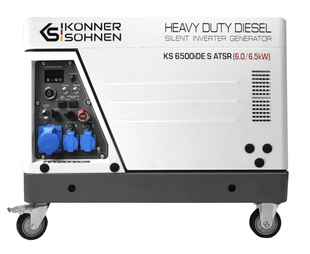
- Diesel generators — KS 6000D, KS 8500DE series. Power from 4.5 to 6.5 kW. More economical for extended work cycles, engine resource is higher.
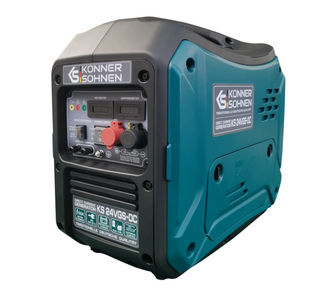
- Inverter generators — KS 2000i, KS 3000i, KS 4000i series. Pure sine wave, harmonic distortion coefficient (THD) less than 3%. Suitable for sensitive electronics and parallel connection of two units.
It is worth separately highlighting models with ATS function (automatic load transfer) and those that support operation in enclosed spaces thanks to an extended exhaust system or a housing with sound insulation.
Technical specifications: what is important to understand
Rated and maximum power
Rated power is how much the generator delivers stably over a long period. Maximum (surge) is the peak value that is only permissible for a few seconds during motor startup. Do not confuse these two indicators when planning your load.
For example, KS 5000E has a rated power of 4.2 kW and a maximum of 5 kW. If you have a 3 kW boiler and a 1.1 kW pump, the total starting load can reach 6–7 kW. Such a configuration for this model is excessive.
Fuel tank capacity and autonomy
The KS 3000E and KS 5000E models have a 15–25 L tank. When loaded at 50–75% of rated capacity, petrol consumption is 1.5–2.5 L/hour. Real autonomy is 8–15 hours of continuous operation. Diesel versions show consumption of 1.2–1.8 L/hour at similar loads.
Noise level
Open petrol units generate 68–76 dB(A) at a distance of 7 m. Inverter models — 58–65 dB(A) at the same distance. The difference is significant: 10 dB is subjectively twice as quiet. If the generator is to be placed near a house or on a dacha plot, noise characteristics are a priority.
Voltage and frequency
The standard for Ukraine is 230 V / 50 Hz. All KS models for the European market comply with this standard. An AVR voltage regulator is present in most models of 3 kW and above — this is a mandatory condition for connecting refrigerators, compressors and pumps.
Series and their differences
KS 2000C and KS 2000i — compact models
Weight 20–23 kg, power 1.8 kW. Suitable for powering a router, lighting, laptop, charging phones and a small refrigerator. The inverter version (2000i) provides more stable current and quieter operation. For permanent home backup — too little power.
KS 3000E and KS 3000i — the most popular segment
Rated 2.8–3.0 kW. Sufficient for a boiler, circulation pump, lighting and charging. The KS 3000i model supports parallel connection: two units in tandem give 5.6 kW with a stable sine wave. This is a practical solution when power is needed intermittently.
KS 5000E and KS 5500E — mid-range segment
Power 4.2–4.8 kW. Cover most of the needs of a suburban house or small office. Variants with electric starter (suffix E) simplify starting in cold weather. Tank from 15 to 25 L depending on the modification.
KS 6000D and KS 8500DE — diesel segment
Diesel generators are more cost-effective with daily use of 4–8 hours or more. Engine resource — from 1500 to 3000 motor-hours before the first major service, which is twice as much as most petrol analogs. KS 8500DE is equipped with an electric starter and has three-phase load connection in some versions.
Advantages of Könner & Söhnen generators
- Availability of AVR in models from 3 kW — protects household appliances from voltage spikes.
- Wide range of power: from 1.8 to 15 kW in a single model line.
- Support for parallel connection for inverter series.
- Extensive service network in Ukraine and availability of spare parts.
- Compatibility with gas conversion kits for a number of petrol models.
- Basic protective relay at low oil level (low oil shutdown) — standard for all series.
- Acceptable price/resource ratio compared to more popular Chinese nameless analogs.
How to choose a Könner & Söhnen generator
Step 1. Calculate real load
Make a list of devices you plan to connect simultaneously. Take into account the starting current of electric motors — it is 3–7 times higher than the rated value. A 24 kW gas boiler has power consumption of 100–150 W, but the pump for it — another 50–80 W. A realistic figure for a house with a boiler, lighting and refrigerator — 2.5–4 kW taking into account starting peaks.
Step 2. Determine fuel type
If the generator is needed 1–2 times a month for short-term backup — petrol. If it will work 4–8 hours daily — diesel. With daily use, the difference in consumption provides savings of 30–40% per year.
Step 3. Decide on power quality
For powering laptops, NAS servers, inverter boilers and medical equipment — only an inverter generator or an external UPS between the generator and equipment. Open generators with AVR provide acceptable quality for household appliances, but not for sensitive electronics.
Step 4. Consider storage and startup conditions
Outdoor temperatures below +5°C complicate manual startup. An electric starter — not a luxury, but a practical necessity for winter use. Models with carburetor heating or fuel supply system even better tolerate cold starts.
Step 5. Check service availability
KS has authorized service centers in most regional centers of Ukraine. Before buying, check where the nearest one is and whether filters, spark plugs and starters for the selected model are in stock.
Typical application scenarios
Private house without gas. Wood or pellet boiler, well pump, refrigerator, lighting — KS 5000E or KS 5500E is sufficient.
Apartment during outages. Router, laptop, charging, refrigerator, lighting — KS 3000i or KS 2000i taking into account actual consumption.
Construction site. Angle grinder, rotary hammer, welding machine — need a generator from 5 kW with stable current. KS 8500E or KS 6500E.
Dacha or temporary facility. Seasonal use, infrequent startups, small load — KS 2000C or KS 3000E.
Small business, café, store. Coffee machine, refrigeration equipment, cash register, lighting. Depending on the coffee machine (1.5–3.5 kW) — KS 5000E or KS 6000D.
Maintenance and operation
Scheduled maintenance for most KS petrol models is every 50–100 motor-hours or once per season. Main operations: oil change (SAE 10W-30 or 10W-40, volume 0.6–1.1 L depending on engine), cleaning or replacing air filter, checking spark plug.
If the unit is stored for more than a month without operation — drain fuel from the carburetor or use petrol stabilizer. Stale petrol is the main cause of difficult starting and carburetor jet clogging.
Before first startup, check oil level — some models are supplied without oil. Startup without oil destroys the engine within minutes.
Where to buy and what to pay attention to
KS generators are sold through official distributors and authorized dealers. It is better to buy from a verified seller with a warranty receipt and the possibility of service maintenance — this is especially important if the unit is planned to be used regularly.
Pay attention to the kit: some models are supplied without oil and with a minimal set of accessories. Check for a warranty document and the duration of service support in your region.
Our store is an authorized KS seller in Ukraine. We will help you select a model for your facility, consult on connection and tell you about available stock.
Frequently Asked Questions (FAQ)
Which KS model to choose for a gas boiler?
For most gas boilers with a capacity of up to 24 kW, a 2–3 kW generator is sufficient. But if there is also a pump station, lighting and several outlets — take KS 3500E or KS 5000E with a margin. The boiler consumes 100–200 W, but pump equipment has starting peaks up to 1.5–2 kW.
Is KS 3000i suitable for a welding machine?
No. Inverter welding machines require a generator with a power of 5–6 kW and stable voltage. KS 3000i is not designed for such load peaks.
How loud does KS 5000E operate?
Approximately 72–75 dB(A) at a distance of 7 m. This is comparable to street traffic or a lawnmower. For a suburban house it is tolerable, for a courtyard — it is better to consider an inverter model or provide distance from windows.
Can KS be connected to the home network via automation?
Yes, if there is an external ATS block (automatic load transfer automation). Some models have a built-in ATS output or compatible connector. Installation is performed by an electrician with installation of a two-pole switch-disconnector and grounding of the generator.
What is the difference between KS 5000E and KS 5000EW?
The W suffix means the presence of a wheel kit and folding handle — the unit is easier to transport. The technical characteristics of the engine and generator unit are the same.
How long does a KS generator last with regular use?
With proper maintenance (oil every 50–100 motor-hours, clean filter, quality petrol) the engine runs 800–1500 motor-hours before the first major repair. Diesel versions — from 1500 to 3000 hours.
Can a gas conversion kit be used?
For a number of KS petrol models there are compatible LPG kits (propane-butane or natural gas). This reduces fuel costs and solves the problem of petrol storage. Check compatibility for the specific model — not all versions support such modification.